When I was ten, I was given a diary for Christmas. It was dark teal with a songbird on the cover and lined pages within. It had a small lock and key and is one of the few childhood Christmas presents that I remember vividly. I loved it. It was to become the first of about thirty diaries that I would keep over the years. I wrote almost every day throughout my teens and then more occasionally but at greater length in my twenties and thirties. My last diary entry was probably around the age of forty-two.
The first few ten-year-old entries were factual and precise. A few sentences outlining what I’d done and eaten that day, what the weather was like. ‘Snowed today. Brr. Great slides at school!’ That type of thing. But very quickly, my sentences gravitated towards detailing my changeable emotional states and jotting down anecdotes, replete with dialogue, of things that had happened to me. For various reasons, I grew incredibly shy during my teens until I stopped speaking all together in class (though I continued to be extrovert outside the classroom). A sort of selective mutism, I realise now. My diaries were my lifeline: they were where I found and developed a voice, where I could be truthful, where I identified and named and explored. Without realising, each time I wrote in my diary, I was on the way to becoming a writer.
But it took a long time. I was forty-eight when my debut novel Black Butterflies was published. En route, I’d written several unpublished short stories and an abandoned first novel. I’d dabbled in journalism for two years. I’d done an MA and PhD in Creative Writing at the University of East Anglia and had taught creative writing for twelve years.
So, that was my journey onto the page.
You might be at any point on your own journey to becoming a novelist. Here’s some of the best advice I can share with you:
Read widely and deeply. Imagine that everything you read breaks down into a sort of fertile mulch inside you. The more you read, the richer this soil will be. This is the soil in which you’ll plant the seed – the initial impulse – of your novel. The richer the soil is, the more nourished your sapling story will be and the stronger your novel will grow. You cannot hope to write a good novel without having read abundantly first.
Ideas are fabulous and addictive. Once you start having them, they keep coming. But multiple ideas alone do not make a novel. Eventually you’ll have to settle on one and stick with it. Or, rather, it will settle on you and not let you go.
Passion. You must be passionate about your subject. You’ll be spending a very long time with your topic, so your enthusiasm for your story has to be genuine and deeply felt. If you don’t care deeply about what you are writing, if it is not very important to you in some way, then how will you be able to sustain your own interest for the duration of writing the novel, let alone the reader’s, if they do ever read it?
Read like a writer. Teach yourself how to write by slowing down and learning to read as a writer. When you experience any shift in emotion while reading– a small gasp of pleasure, a growing sense of unease, tears, laughter, fear – stop and examine the inert black marks on the page closely. How has the author used words and punctuation to create the emotional response in you? Be very precise as you tune into this. Notice the effect of word choice, the spaces and paragraph breaks, the use of images and the senses, the speeding up and slowing down of time, and the flavour and rhythm dialogue adds. Francine Prose’s excellent Reading Like a Writer encourages deep, slow reading of literature to glean what you can as a writer.
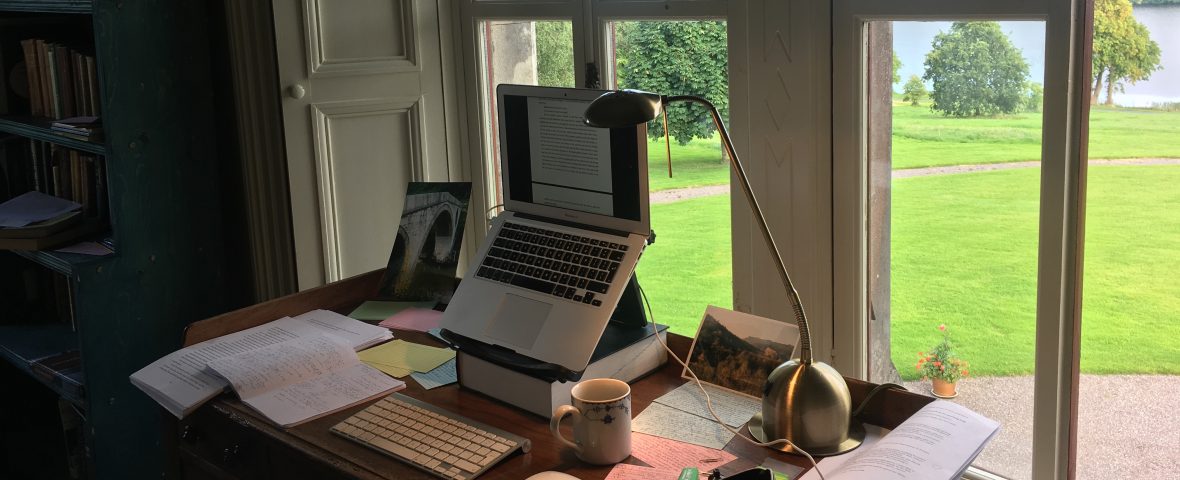
Write, write, write. Of course, attentive reading alone will not make you a writer. Attending a workshop and accumulating writerly friends, will not make you a writer. To be a writer, you have to write. To be clear, this means putting down word after word after word on the page. It doesn’t matter if you use a pen or a laptop or a mixture of both – and do experiment to discover which helps your voice and story flow better. The important thing is that you set aside time each day or each week and write as much as possible. Every word you put down and each sentence you construct mean you’re a step closer to becoming a writer. It’s said that you need to write a million words to nail the business of writing. Don’t get hung up on the number but do listen to the message: it takes time and a lot of writing to learn the craft and develop your unique writer’s voice. Happily, diary writing, journalism, writing endless abandoned drafts of short stories and novels, morning pages, and all other forms of narrative writing very much count.
Writing workshops. Some are wonderful, some are detrimental. Exercise your judgement! I left two workshops because they weren’t right for me. I found them more discouraging than supportive. However, the workshops I attended as part of my MA in Creative Writing were, without exaggeration, life-changing. They were expertly guided by published authors and it was invaluable to make friends with my fellow novice writers and to have their eyes on my work. Along with reading as a writer, opening your work to critique and learning how to critique others’ work can hugely speed up your development as a writer. If you’ve been writing ‘in the dark’ for a while, do consider signing up to physical or online workshop. A good one will galvanise and inspire you, show you your writerly blind spots, point out aspects of the craft it may have taken you ages to work out on your own and connect you with like-minded people. Two excellent how-to books written by seasoned workshop facilitators are: Sarah Burton and Jem Poster’s The Book You Need to Read to Write the Book You Want to Write. A wonderful all-round book on the craftwith great illustrative novel extracts and a superb chapter on research. Andrew Cowan’s The Art of Writing Fiction isbrimming with wise advice and writing exercises.
Copy a chapter or short story. This may sound like a dull, mechanical exercise, but it certainly worked for me. Select a short story or chapter you love. Copy it out word for word, punctuation mark for punctuation mark. Make sure the paragraph breaks, indents and all formatting are exactly the same as in the original. You can do this on your screen or by hand. You’ll be amazed at what you learn about the craft of writing.
Deal with Resistance. There will be plenty of inner and outer resistance that threatens to topple your writing process. In many ways, completing a full draft is a process of overcoming these blocks and demons. Everyone has them, so the first step is to acknowledge what stops you getting to your desk or what has you getting up again fifteen minutes later. Low self-confidence? Harsh inner critic? Backache? Headache? Noisy, demanding family? No writing nook of your own? An oven that needs to be cleaned? A yoga class you must go to? Perfectionism? Listening to people who say, ‘What, not published at 20/35/70? You’ll never be a writer!’ My sister, a life coach, suggested the following when I was struggling to finish Black Butterflies. Write a list of all the things that obstruct you. Write a solution next to each one (if it can be solved). Pin the list up above your writing space. Each time the source of resistance comes up, you can either simply acknowledge it and write on or deal with it and, when appropriate, write on. Read Anne Lamott’s Bird by Bird to understand that all first drafts are ‘shitty’ and get over perfectionism.
Relax. It’s not all about sitting at your desk. Sometimes I come to an impasse when I’m writing and it’s often a problem of some sort. For instance, I’m not sure how a character would respond in a certain situation or I’m not convinced by how I’ve transitioned between scenes. It often helps to formulate the problem, write it down as a question, and then leave it alone. Go for a long walk, have a bath, dance with some friends, have a glass of wine. The answer may well bubble up when you’re most relaxed and your attention is elsewhere.
Persist, persist, persist. Writing a novel is a long game. Keep your energy up, your enthusiasm lit. Deal with your resistance. If you bloody-mindedly stick at it, you’ll get there in the end!
Happy writing and bon courage, my friend!
Warm wishes
Priscilla x
PS Consider exploring my reading recommendations and signing up for one of my online workshops
* this mostly applies to short story writers too!
 PRISCILLA MORRIS